


Abbey Pain Scale: Assessing Pain in Dementia
The Abbey Pain Scale helps carers assess pain in people with late-stage dementia who cannot speak. It relies on observation to ensure comfort for those unable to verbalise their needs.


Abbey Pain Scale
Designed for assessing pain in people with dementia who cannot verbalise their needs, the Abbey Pain Scale is an essential observational tool. It evaluates six signs, including vocalisation and facial expressions, ensuring effective pain management for non-communicative patients in aged care settings.
Category
Disease
Source
What is Abbey Pain Scale

The Abbey Pain Scale is a trusted tool for assessing pain in people with late-stage dementia who can't speak up. It helps care staff spot hidden distress quickly. This observation method looks closely at six specific signs of discomfort. It focuses on non-verbal cues like vocalisation, facial expressions, and shifts in body language. Raters score each item from absent to severe based on exactly what they see. The total score ranges from zero to eighteen, categorising pain as no pain, mild, moderate, or severe. This simple system makes it easy to track symptom changes over time. It is handy for aged care settings where residents cannot tell you they hurt. Nurses can use it during routine checks or after giving medication to see if it worked. By relying on observation rather than questions, it ensures vulnerable patients get the relief they need without any guesswork involved.
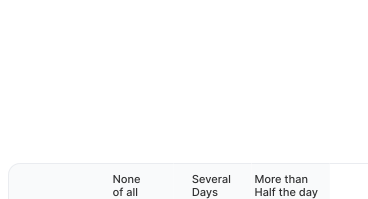
The Abbey Pain Scale can be scored using a simple summation method. First, you'll rate six specific signs, such as vocalisation, facial expression, and body language changes, on a scale from 0 for absent to 3 for severe. Next, you just tally these numbers up to get a total score ranging between 0 and 18. It's really handy for sorting pain levels: 0 to 2 means no pain, 3 to 7 is mild, 8 to 13 suggests moderate pain, and anything over 14 indicates severe distress. This quick check helps nurses spot and treat discomfort in residents with dementia who can't speak up for themselves.
Advantages

Enables precise identification of patient health status.
.svg)
Simple to understand and complete for patients.
.svg)
Measures healthcare intervention results systematically.
.png)

Related Instruments

Digital counterpart
Digital biomarkers that measure the same thing with sensors rather than a questionnaire.
Collect Abbey Pain Scale data with WeGuide, the all in one patient engagement platform
.jpg)

Support Your patient in no time - all under your own brand
Our platform combines the knowledge of 100+ digital health solutions built, letting you easily build your patient engagement app for research or clinical use. Collect PROMs, support patients on waiting lists, or gather vital signs data. This is how:
Learn More.png)
Program Builder
.png)
.png)
Whitelabelling
.svg)
.svg)
.png)
Turn on components, dependent on your usecase
.svg)
.png)
Support The Full Journey
.png)
.png)
%20(1).png)
.png)
It’s your turn
Every WeGuide project, saves researchers and clinicians - 9 months and $450,000 - creating impactful digital health solutions.
